
You want chickens. You can picture the eggs in the morning and the kids carrying armfuls of birds. Here is what I want you to picture too:the coop site in the rain,the fencing in the brush,the water in January,and what the county actually allows on the parcel.
That is the part nobody tours,and it is the part that decides whether chickens work on a property,or whether you find out after closing that they never fit.
I keep a flock on our acreage near Springfield,and I have walked enough Lane County properties with buyers to know exactly which questions to answer before an offer. This is that list.
"Before you close, ask what the property will let you do,not just what it looks like."
Start with Zoning: Can This Property Actually Have Chickens?
The good news:in unincorporated Lane County,chickens are a normal part of rural life. Poultry is an expressly permitted use in the county's Rural Residential zone,which covers much of the acreage buyers are looking at. No special permit is required for a small flock.
The catch:zoning is parcel-specific. Whether the parcel sits on unincorporated county land or inside a city boundary changes the answers,so check the parcel,do not assume the area.
- Unincorporated Lane County:chickens are allowed in Rural Residential zoning,with animal counts capped by acreage. Verify the zone for the exact parcel.
- City limits:rules tighten. Eugene allows up to six hens on residential property. Springfield limits farm animals by lot size and bans roosters. If the property sits in a smaller town,pull that city's code.
- Roosters:allowed on unincorporated land,but subject to noise and nuisance rules. Banned inside Eugene,and Springfield city limits.
- Coop placement:city codes often require coop setbacks from property lines. Check before you build,not after.
How Much Space Does a Small Flock Actually Need?
A small flock does not need a farm. It needs the right setup.
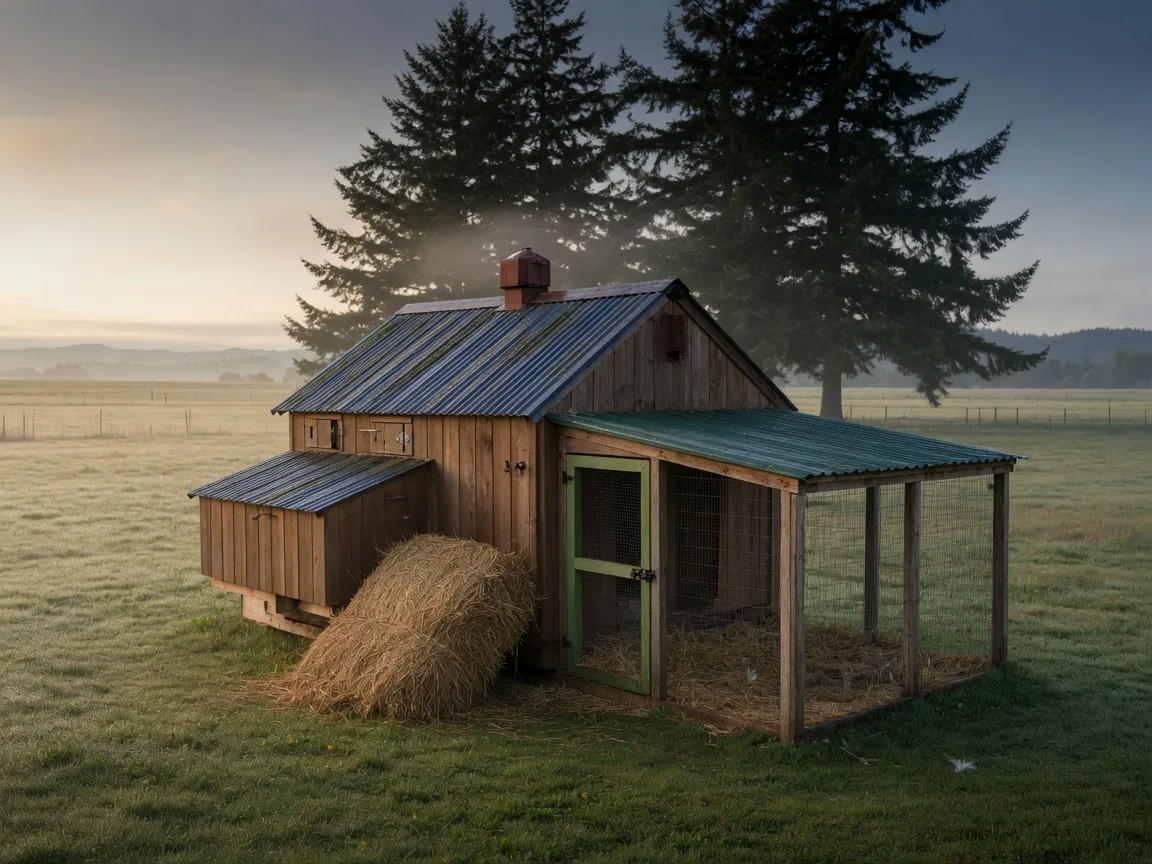
Start with bird count,because it drives everything. Six standard hens need roughly 24 square feet of coop floor and 48 to 60 square feet of run. That comes out to about three to four square feet per bird indoors,and eight to 10 outdoors.
- Coop floor:three to four square feet per standard hen
- Run space:eight to 10 square feet per bird
- Roost bar:eight to 10 inches per bird
- Nest boxes:one per three to four hens
Predators Are the Real Test in Rural Oregon
The suburbs have raccoons. Rural Lane County has raccoons too, plus foxes, coyotes, bobcats, weasels, skunks, opossums, loose dogs,and raptors. Hawks by day,owls at dusk,and eagles from the sky. They are why saying birds are safe in the yard is not nearly enough.
Predator-proofing is buildable,but it is non-negotiable. Here is what matters:
- Skip the chicken wire. Use half-inch hardware cloth,which raccoons cannot tear open.
- Bury the fencing six inches to a foot deep,so foxes,coyotes,and dogs cannot dig under.
- Cover the run overhead,so hawks,and owls cannot drop infrom above.
- Lock the flock in the coop every night,and use latches a raccoon cannot work open.
- Keep brush piles down near the coop,so predators have nowhere to hide.
One more thing:eagles, hawks,and owls are protected by federal law. Exclusion is the legal answer. Removal is not.
Water: The Chore Nobody Puts on the Tour
A hen drinks more than most people expect,and in winter,that water freezes. Someone has to carry it,and on acreage,that someone is usually you.
Plan the coop spot so a water source is reachable,or plan the walk. And plan for what happens when temperatures hold below freezing:a heated base or waterer is the difference between morning chores that take five minutes,and ones that take an hour.
Winter in Lane County: Wet First,Cold Second
Oregon winters are more wet than bitter cold. The enemies are moisture,and drafts,not deep cold.
A dry,draft-free coop with ventilation near the roof keeps birds comfortable. Frostbite on combs,and wattles comesfrom moisture,not cold,so dryness does the real work.
- Change bedding before it goes soggy,and keep it deep
- Block drafts at bird level. Keep ventilation high,so moisture,and ammonia escape
- Refill with warm water,and add a heated base or waterer when temps hold below freezing
- Collect eggs promptly so they do not freeze,and crack
- A little cracked corn or black-oil sunflower seeds on cold afternoons helps birds stay warm
What It Costs to Start
For a small flock of four to six hens,budget roughly $700 to $1,500 for the first year with a DIY coop. A prebuilt coop pushes that higher. Here is where the money goes:
- Coop:$100 to $400 for a basic DIY build,and up to $2,000 or more for prebuilt
- Run and fencing:$100 to $300
- Starter flock:$150 to $350,whether chicks,pullets,or adult hens
- Feeders,and waterers:about $50
- Feed:about a pound anda half per hen per week
"The real question is not whether you can handle chickens. It is whether the property will let you,and whether you have planned for what the birds need in January."
Before You Make an Offer
Here is the short checklist I run through with every acreage buyer planning a flock:
- Pull the zoning for the exact parcel,and check city limits
- Check rooster rules,and coop setbacks
- Walk the future coop site:sun,drainage,run space,and water reach
- Plan for winter water
- Budget the coop,fencing,flock,and the first months of feed
Free Acreage Buyer Checklist
If you are serious about acreage,the free checklist I built for Lane County buyers covers zoning, wells, septic, easements,and carrying costs:the full due-diligence list,not just the birds.
Your Next Step
Before you commit,you should be able to picture your January morning:water flowing,birds locked in safe,coop dry. That is a picture worth having.
If you want a clear picture of what chicken-keeping would actually look like on a property you are considering,and what the county will actually allow there,I will walk it with you.