
When you buy acreage in Lane County, the water question arrives before most others: well or city?
It is the right question. The version that helps you decide is bigger: what does the supply cost to get, what does it cost to keep, and what does it do in January?
I keep a well pumping on our own acreage near Springfield, and I have walked enough Lane County properties with buyers to know exactly which questions to answer before an offer. This is that list.
"The real question is not which water source is better. It is what each supply costs to get, what it costs to keep, and what it will do in January."
The Fork in the Road Is Simple
On acreage, you are almost always choosing between two things: a private well on the parcel, or city water piped to the lot line.
City water is a utility. The water shows up, the bill shows up, and a public system does the testing. Your job is the connection charge and the monthly payment.
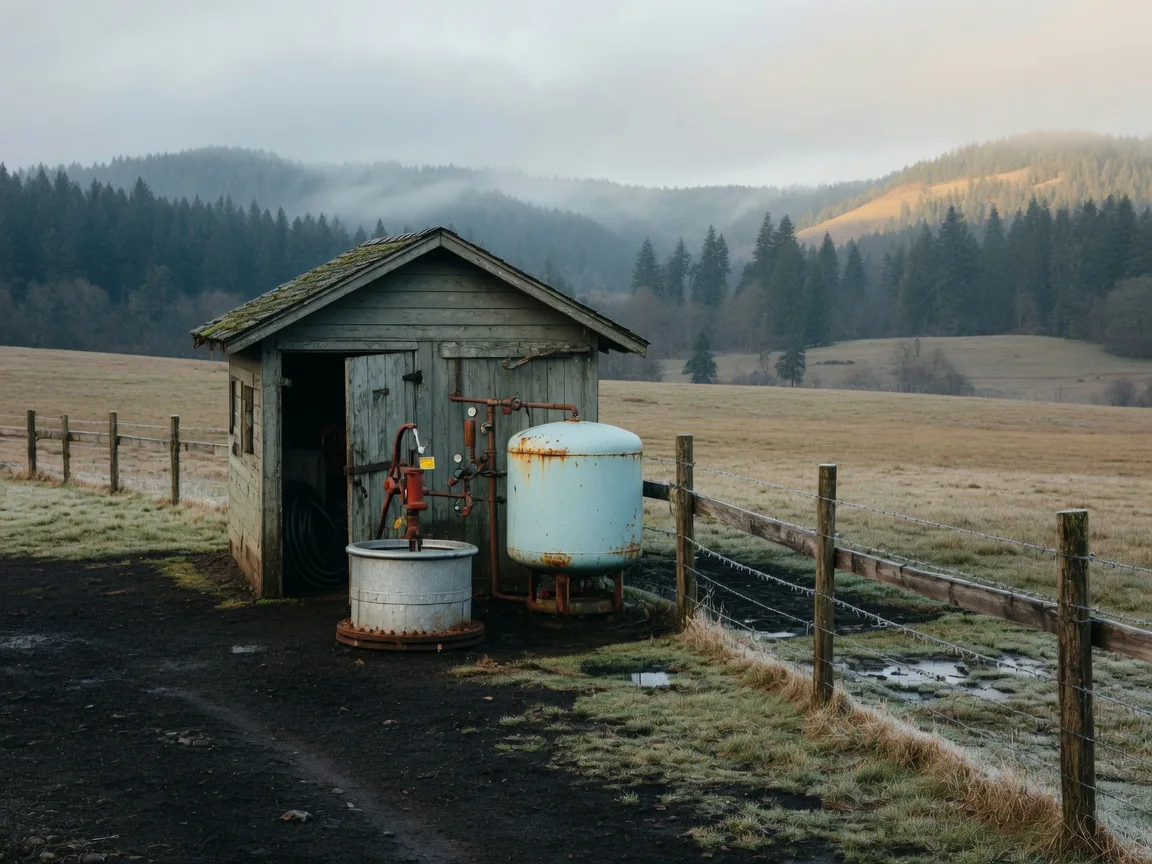
A well is a system you own. The pump, the pressure tank, the casing, the treatment if you need it. There is no bill every month. There is a chore list, and a savings account for the day something fails.
Neither is good or bad. They are different agreements, and the right one depends on the parcel and the life you are planning.
What Oregon Law Requires When You Buy a Home with a Well
Oregon has a rule that protects you at the moment of purchase. It is the Domestic Well Testing Act, and it applies whenever a home with a domestic well is sold.
After an offer is accepted, the seller must have the water tested at a state accredited laboratory for three things: arsenic, nitrate, and total coliform bacteria. The results go to you, they are valid for one year, and the testing cannot be waived in the contract.
That is a real protection. Know what it is not: a full check of the well system. It tests the water in the glass. It does not tell you how fast the well refills, how old the pump is, or what January looks like.
The Two Things a Well Test Does Not Tell You
The sale test tells you whether the water is safe to drink today. Two more questions decide whether the well can run your household for the next twenty years: flow rate and equipment condition.
Oregon requires every completed well to be tested for yield and drawdown for at least one hour. County building standards often accept a minimum of about one gallon per minute when storage is added, but lenders and appraisers expect more. For a family home, the practical target is 3 to 5 gallons per minute, and some loan programs look for 5 gallons per minute sustained over four hours on new wells.
That is why the sale test matters, but so does a separate inspection of the physical well: the pump, the pressure tank, the casing, the wiring. They are two different reports, and on acreage you want both.
Lab tests run about $20 to $45 each. The flow and equipment inspection is its own line item. Together they are the cheapest insurance on the property.
What Drilling a New Well Costs, If It Comes to That
If the parcel has a well, you mostly want to know about the one in the ground. But knowing the replacement number changes how you read a listing, so here it is:
- Drillers in Oregon typically quote $28 to $65 per linear foot, and a typical residential well in the state runs about 200 feet deep.
- A complete project, working system included, averages around $8,400. Pump and installation alone run about $1,000 to $3,000.
- Most single-family wells are exempt use under Oregon law, which means no water right permit is needed. The driller records the well with the state and pays a one-time $300 groundwater use recording fee.
- If you drill it yourself instead of hiring a licensed driller, Oregon charges a $550 landowner well construction permit.
A property without a well, or with a weak one, is not a dealbreaker. It is a number on the ledger. Now you know what the number looks like.
What Lane County Groundwater Is Actually Like
Here is what the labs have found around here, because it shapes what you should ask for.
Arsenic is a real one. Parts of the Willamette Valley contain high levels of naturally occurring arsenic in groundwater, and the Oregon Health Authority says so plainly. In a USGS study of the Willamette Basin, about 8 percent of roughly 725 groundwater samples came back above the drinking water standard in effect at the time, and today's federal limit is stricter, not looser.
Arsenic is treatable with the right system. The point is to know it before closing, not after, because treatment adds a line item to the budget.
Nitrate is the opposite story across most of Lane County. The state DEQ's assessment of the southern Willamette Valley reviewed 782 private wells: 43 showed nitrate at 3 mg/L or above, and only one exceeded the federal limit of 10 mg/L. Where it does show up, it concentrates in the western, agricultural part of the valley.
In plain terms: well water here is usually good, sometimes needs treatment, and the only way to know which applies to your parcel is to test the actual well.
The City Water Side of the Ledger
Now the other column. City water has a predictable bill, and in the Eugene-Springfield area the utilities are large, established systems.
Eugene water runs through EWEB. The base monthly fee for a standard residential meter is $26, and usage runs $1.985 per 1,000 gallons on the first 8,000. A typical household bill lands around $39 to $46 a month.
Springfield water runs through SUB. The fixed monthly customer service fee for a 3/4-inch meter inside city limits is $29.40, plus your metered usage.
The entry cost is real. A new EWEB residential connection runs about $2,750 to $2,850, plus a meter fee of $275 to $375 depending on size, with system development charges on top.
On an acreage parcel, ask whether city water is available at the line at all. Many rural parcels are not plumbed for it, and running a line from the road can be a large project. If it is available, the monthly bill is the easy part.
Which One Should You Choose?
Here is what matters: there is no universal right answer. There is only the answer that fits the parcel and your family.
If city water is available at the line, the decision is mostly financial: the connection cost and a predictable bill, versus owning the entire well system.
If the parcel is well only, do not ask whether wells are good or bad. Ask what this specific well does: its flow test, its water test, its age and equipment.
And know the difference between the two kinds of rights people talk about. Water rights govern who may use water. In Oregon, a well serving a single household is exempt use, so it needs no separate water right permit. Mineral rights are a separate question about what sits under the ground, and they can be owned apart from the surface. Both belong on the title report, not in a guess from the listing.
The Checklist Before Any Acreage Offer
- Require the seller's testing from the sale: arsenic, nitrate, and total coliform, from a state accredited laboratory.
- Order a physical well inspection: pump, pressure tank, casing, wiring, and a flow test in the range a family home needs, 3 to 5 gallons per minute.
- Ask for the well record: depth, casing, and the date of the last test. Completed wells in Oregon have a state record you can pull.
- If the parcel has no well, put the drilling number on the ledger: $28 to $65 per foot and around $8,400 complete, before you fall in love with the view.
- If city water is available, get the connection quote in writing, including the meter fee and system development charges, before you compare the two columns.
Free Acreage Buyer Checklist
Every water question from this post is on the free checklist I built for Lane County buyers, alongside septic, zoning, easements, and carrying costs. It is the list I walk acreage buyers through before any offer.
Your Next Step
Water is the first system on acreage, and the one buyers are least prepared for. You do not need to become a well expert to buy well. You need the right questions and the right records, before the offer instead of after.
If you want to run your property's water question past someone who does this every week, book a free 30-minute call. We will go through the tests, the numbers, and what the parcel really says.